


Hallway Rugs: Durable, Stylish & Enduring
TL;DR: The ideal rug for your hallway combines extreme durability with easy-care properties. Flatweave rugs like Kelim or low-pile rugs made from virgin wool are best. These materials are naturally dirt-repellent and resistant to high footfall. Pay attention to the correct size to ensure doors swing freely and create a harmonious overall look.
Why Your Hallway Has Special Demands for a Rug
Your hallway is the calling card of your home and simultaneously one of its most heavily used areas. A rug here must withstand high footfall, street dirt, and moisture. It should therefore be extremely hard-wearing, dirt-resistant, and easy to clean, without losing its homely aesthetic. The narrow, elongated shape often requires a specific runner format.
The hallway is more than just a passageway – it's the first handshake your home gives a guest. It's where the decision is made whether one immediately feels welcome and comfortable. At the same time, it's a room of extremes: street shoes bring in moisture and dirt, shopping bags are put down, children run through. The mechanical stress on a floor covering here is as high as anywhere else in the home. A rug must not only withstand this daily ordeal but also look good while doing so.
The challenge lies in finding a rug that meets these functional requirements without compromising on aesthetics. It needs to combine the durability of a doormat with the warmth and style of a living room rug. Moreover, hallways are often architecturally challenging: long, narrow, and sometimes winding. A standard rug rarely fits here. You need a format, usually a runner, that complements the room's proportions and accentuates it favourably, rather than making it feel cramped.
I remember a customer who came to our Hamburg warehouse a few weeks ago. She was frustrated because she had worn out her third inexpensive synthetic runner for her hallway in two years. The last one looked flattened after just a few months and had track marks that could no longer be removed. She said: "I need something that lives and lives with us, not something that gives up after a few steps." That's precisely the point: a hallway rug is not a disposable item, but a fundamental part of your home that greets and bids you farewell every day.
The Best Materials: What Makes a Hallway Rug Truly Robust
Virgin wool is the best material for a hallway rug. Its natural lanolin content acts like an impregnation, repelling dirt and moisture and keeping the fibre elastic. Flatweave Kelim made from wool are particularly ideal, as they have no high pile where dirt can settle. They are durable, hard-wearing, and easy to clean.
When it comes to durability and ease of care, choosing the right material is crucial. Synthetic fibres like polypropylene or polyester might seem inexpensive and colourful at first glance, but they have significant drawbacks in high-traffic hallway areas. They tend to attract dirt electrostatically, and constant pressure quickly flattens the fibres, leading to unsightly 'traffic lanes'.
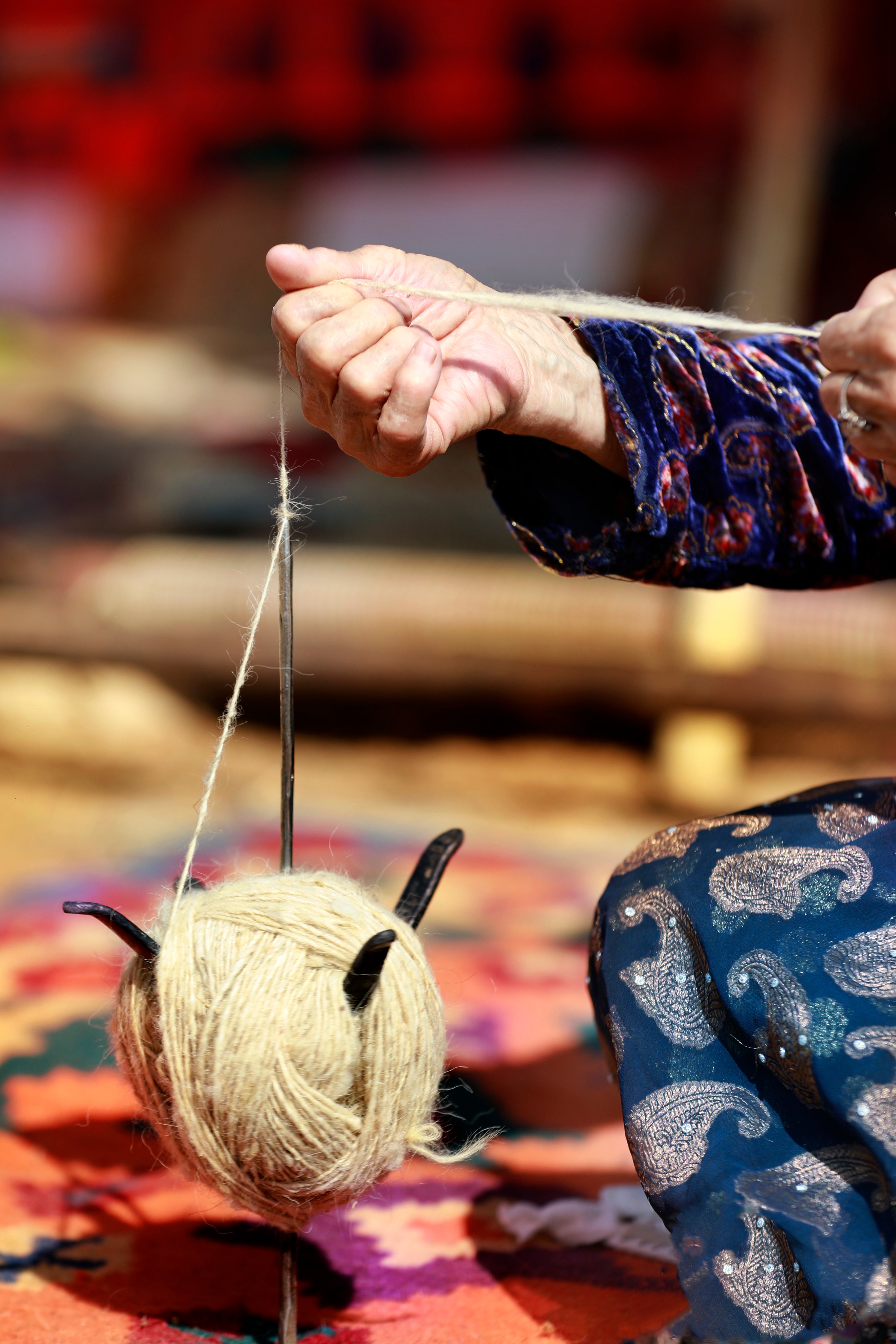
Nature has a far better solution: virgin wool. In particular, the wool from mountain sheep in the Persian highlands is a true marvel of functionality. Due to the harsh climate, the sheep develop a particularly dense and resilient fleece with a high lanolin content, which is natural wool grease. This lanolin coats each individual fibre, acting like a protective shield. It simply repels dirt and water droplets, preventing them from penetrating deep into the weave. This is why a good wool rug can often be cleaned by simply vacuuming or shaking it out.
Moreover, the wool fibre is naturally crimped, giving it enormous elasticity and dimensional stability. Even if a heavy piece of furniture stood on it, the pile will eventually spring back into place. This characteristic makes virgin wool perfect for the hallway, where constant stress is the norm. The foundation for many of our rugs is often cotton for the warp and weft, which gives the rug additional stability and structure.
| Property | Virgin Wool | Synthetic (e.g., Polypropylene) |
|---|---|---|
| Dirt Behaviour | Naturally repellent (Lanolin) | Attracts dirt statically |
| Durability | Very high, fibres spring back | Low, quickly forms traffic lanes |
| Cleaning | Easy, often self-cleaning | Stains penetrate deeply |
| Feel & Climate | Warm, breathable, moisture-regulating | Cold, not breathable, can off-gas |
| Longevity | Decades, becomes more beautiful with age | Few years, visible wear |
The decision for virgin wool is an investment in longevity. A hand-knotted wool rug lasts for generations, while a synthetic rug often needs to be replaced after a short time. Since our founding in 1952, our 6th-generation family business has learned that quality always pays off.
Kelim & Co.: Why Flatweaves Are the Heroes of the Entrance Area
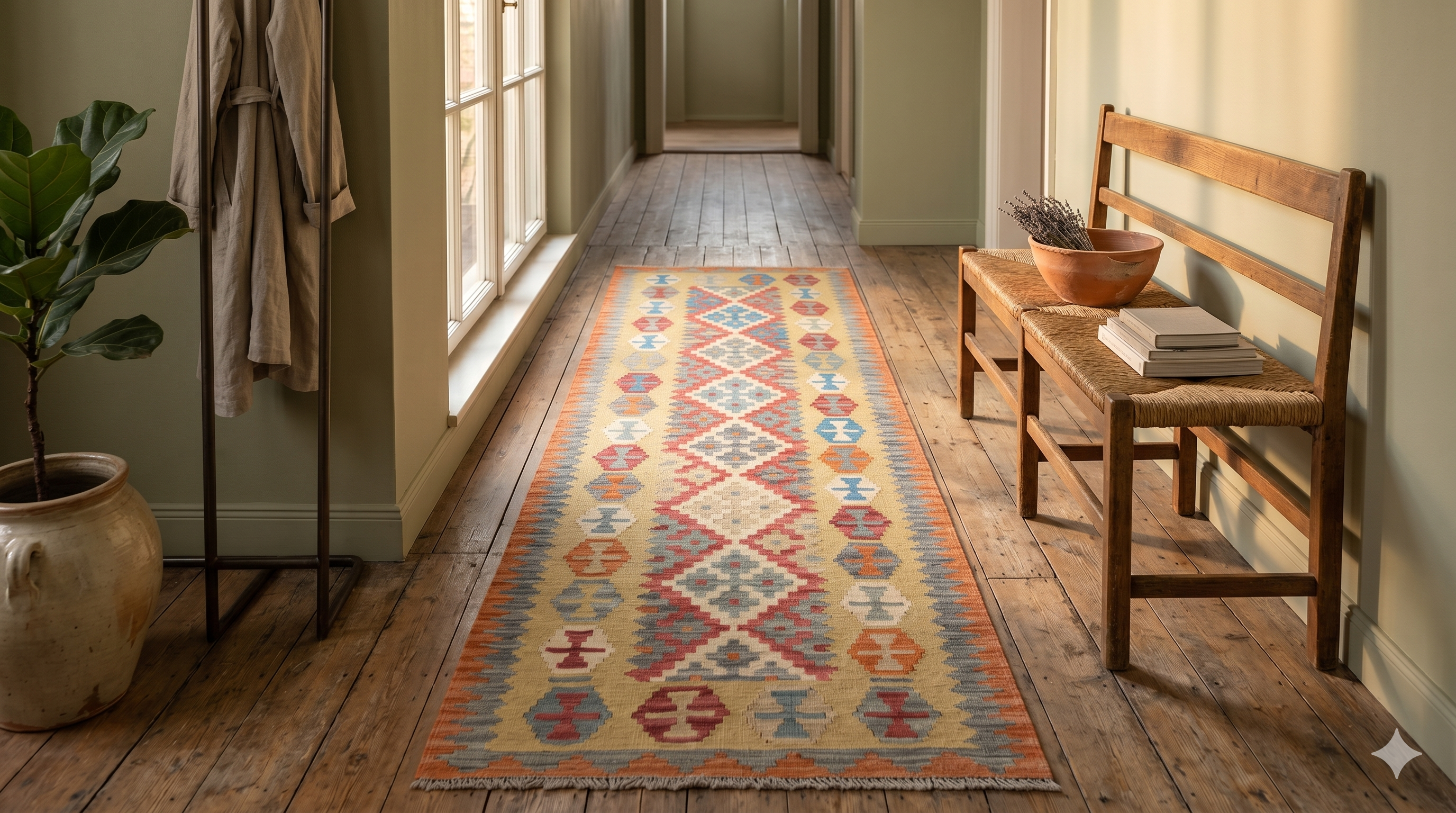
Flatweave rugs like Kelim are the first choice for the hallway. Their flat structure without a pile means dirt and dust can hardly settle, which greatly simplifies cleaning. Doors can easily open over them, and they are extremely hard-wearing. Moreover, many Kelim are reversible, practically doubling their lifespan.
Within the world of wool rugs, there is a category that seems made for the hallway: flatweaves, especially the Kelim. In contrast to knotted rugs with an upright pile, a Kelim is woven, similar to a tapestry. The result is a flat, dense, and incredibly robust structure.
This construction offers several unbeatable advantages for the entrance area. Firstly, the low height is a blessing. Front doors, wardrobe doors, or room doors can easily glide over the rug without snagging or shifting it. Secondly, the absence of a pile makes it extremely easy to care for. Dirt, crumbs, or pet hair remain on the surface and cannot penetrate deep into the weave. A good shake or a quick vacuum (without a brush) and the Kelim is clean again.
Vida ter Hazeborg, Co-Founder: "For me, a Kelim is the epitome of practical beauty. It brings colour and life to an often-neglected space like the hallway, without being delicate. Many of our customers are amazed at how much such a rug can withstand. The great thing is: many Kelim are woven identically on both sides. You can simply flip them over, which doubles their lifespan and ensures even wear."
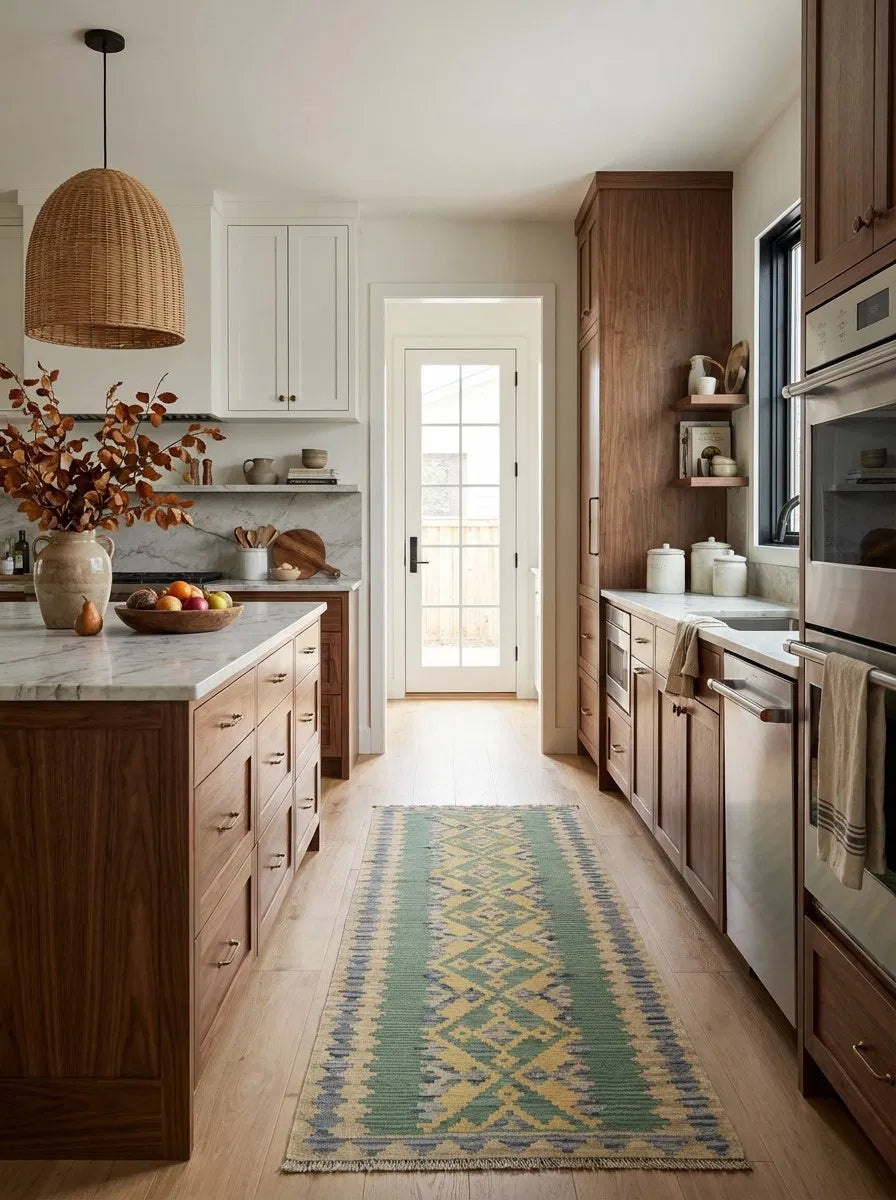
The weaving technique also allows for an incredible variety of geometric patterns and vibrant colours. Whether a traditional Kelim Gashgai with its powerful symbols or a modernly interpreted runner – a Kelim adds character to the hallway without visually overwhelming the narrow space. It is a work of art for your floor that stands up to daily challenges. So, if you're looking for the perfect rug runner for your hallway, chances are you'll find it in our selection of handwoven Kelim pieces.
The Right Size and Shape: How to Make Your Hallway Appear Larger
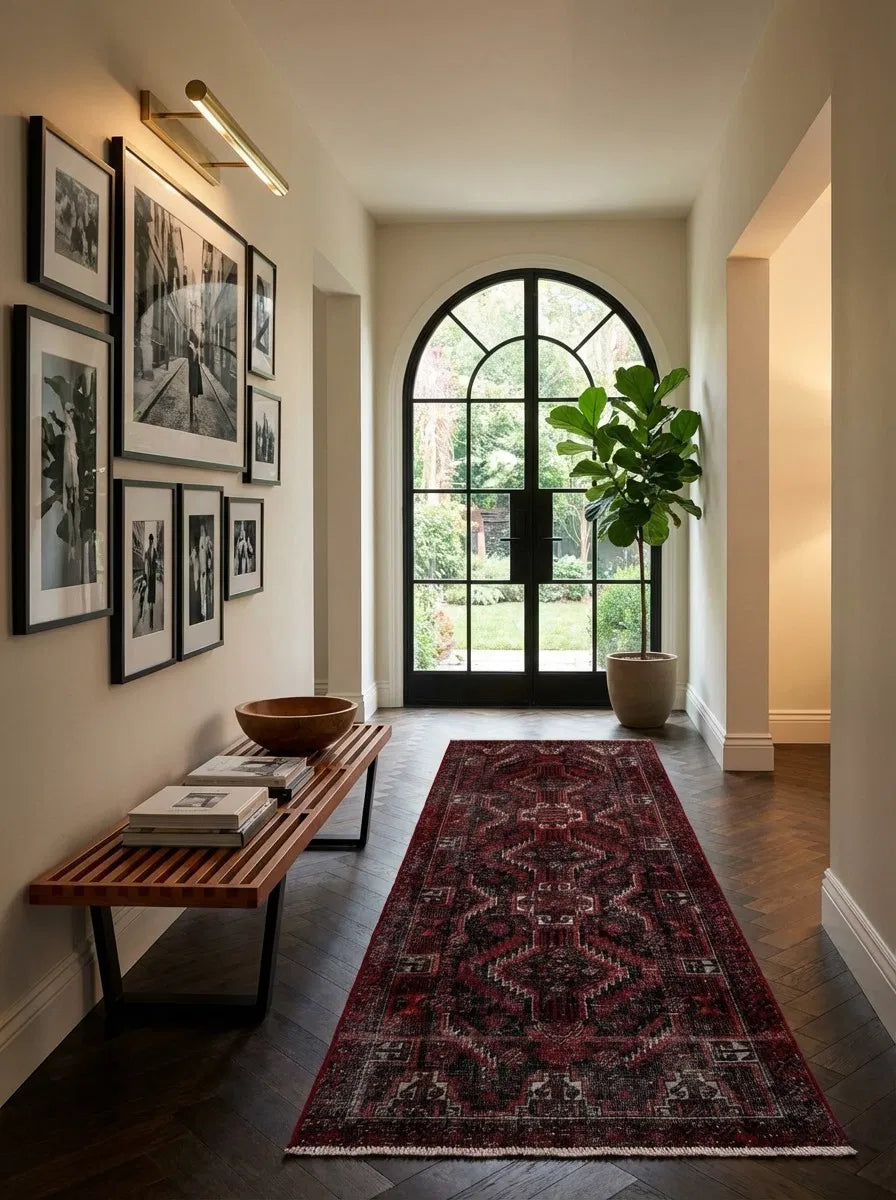
The correct rug size is crucial for the impression your hallway makes. As a rule of thumb: leave about 15-20 cm (approx. 6-8 inches) of the floor visible along the long sides. The rug should cover the main walkway but not fill the entire width. This creates a clear line that visually elongates the space, making it appear larger.
The wrong rug size can overwhelm a hallway and make it appear smaller than it is. A rug that is too wide, almost reaching wall-to-wall, makes the space feel cramped. A rug that is too short looks lost and disproportionate. The art lies in choosing a size that defines and guides the space without dominating it.
The most important rule is: show some floor. Along the long sides of the rug, ideally, 15 to 20 centimetres (approx. 6-8 inches) of the underlying floor should remain visible. This frame creates a clear visual line that draws the eye lengthwise, thereby visually elongating the hallway. The rug should mark the main walkway but not cover the entire space. The same applies to length: the runner should not start directly at the doorstep or end at a wall. A little space at both ends creates breathing room and makes the overall impression more harmonious.
In our Hamburg warehouse, we have now inspected and prepared over 6,290 hand-knotted pieces for sale. We consistently see how crucial the proportions are. A well-chosen runner can transform a narrow, dark hallway into an inviting and elegant entrance area. To help you decide, we have integrated an AR Visualiser on our website. With your smartphone, you can virtually place any rug to scale in your own hallway. This way, you'll immediately see which size and pattern fit best. You can find out more in our detailed rug sizing guide.
Care Tips: How to Keep Your Hallway Rug Beautiful for Years
Caring for a wool rug in the hallway is straightforward. Regular vacuuming without a brush attachment removes loose dirt. Stains should be blotted immediately with a damp cloth and a little wool detergent, not rubbed. Every few years, a professional wash can refresh the colours and nourish the fibres, just as we do in our Hamburg warehouse.
The durability of a hand-knotted wool rug is also evident in its simple care. Forget complicated cleaning rituals. The most important thing is regular, but gentle care. Vacuum your hallway rug once or twice a week with a smooth nozzle. Avoid rotating brush attachments, as these can over time put too much strain on the wool fibres.
Another simple yet effective tip is to rotate the rug 180 degrees every six to twelve months. This ensures it is worn and faded evenly, especially if one side receives more sunlight or more traffic. With a reversible Kelim, you can also flip it over on this occasion.
Should a mishap occur – a spilled drink or a muddy paw print – prompt action is required. Absorb liquids immediately with an absorbent cloth or kitchen paper. Gently lift solid dirt with a spoon. Then, gently blot the stain from the outside in with a clean, damp cloth and possibly a little pH-neutral wool detergent. Important: Never rub, as this works the dirt deeper into the fibres.
Every three to five years, depending on usage, we recommend a professional hand wash. In our Hamburg warehouse, where we organically wash every rug before sale, we refresh the colours and deeply nourish the wool fibres. This way, your rug remains a faithful companion for many years.
FAQ
Which rug is suitable for a hallway with a dog or cat?
For households with pets, robust, low-pile wool rugs like Gabbeh or flatweaves like Kelim are ideal. The dense virgin wool is dirt-repellent and hard-wearing due to its natural lanolin. The short fibres or flat weave offer little grip for claws, and hair can be easily vacuumed up.
Can you place a rug on tiles in the hallway?
Yes, absolutely. A rug on tiles provides warmth, reduces impact noise, and creates a homely atmosphere. To ensure safety and prevent slipping, we strongly recommend using a non-slip rug underlay. This also protects both the rug and the tiled floor beneath it.
How long should a rug runner be in the hallway?
A runner should cover the main walkway but not fill the entire hallway. Leave about 20-30 cm (approx. 8-12 inches) of space at both ends – in front of the front door and at the end of the hallway. This prevents the rug from looking cramped and maintains the harmonious proportions of the room. It should not end directly at a doorstep.
Are light-coloured rugs unsuitable for the hallway?
Not necessarily. Hand-knotted wool rugs, especially those with mottled patterns or natural colour variations (known as Abrash), are surprisingly forgiving. Small specks of dirt are barely noticeable within the vibrant texture. Moreover, the natural lanolin content of wool ensures that dirt only adheres superficially anyway and can be easily removed.
What is the advantage of a hand-knotted rug in the hallway?
The key advantage is its longevity and reparability. A hand-knotted wool rug is a lifelong investment that, with good care, will last for decades and often even increase in value. Unlike machine-made rugs, it can be repaired by experts if needed. Each piece is unique with its own story.
Ready to transform your entrance area? A good rug makes all the difference between a simple passageway and a warm welcome. Discover our collection of robust and stylish runners, specially selected for the demands of the hallway. With our AR Visualiser, you can try on your favourite directly in your home.