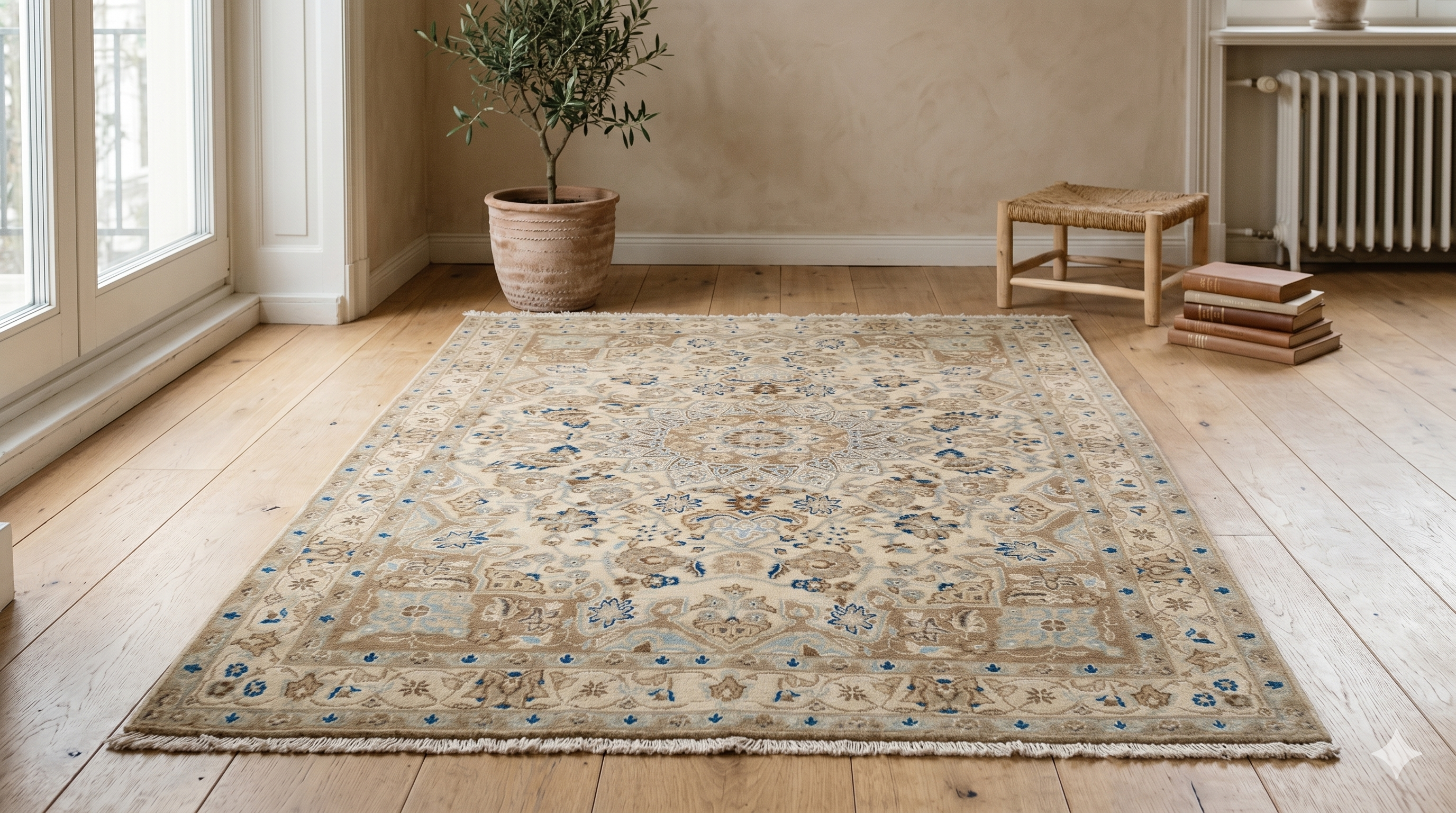
How to Spot an Authentic Hand-Knotted Rug — 7 Tips
TL;DR: To identify a genuine hand-knotted rug, inspect its reverse: the knots should be visible and slightly irregular, with the pattern mirroring the front. Authentic fringes are an integral part of the warp threads, not sewn on. Look for natural materials like wool, subtle irregularities in the design (Abrash), and hand-serged edges as hallmarks of authentic craftsmanship.
1. The Knot Test: The Heart of Handmade Craftsmanship
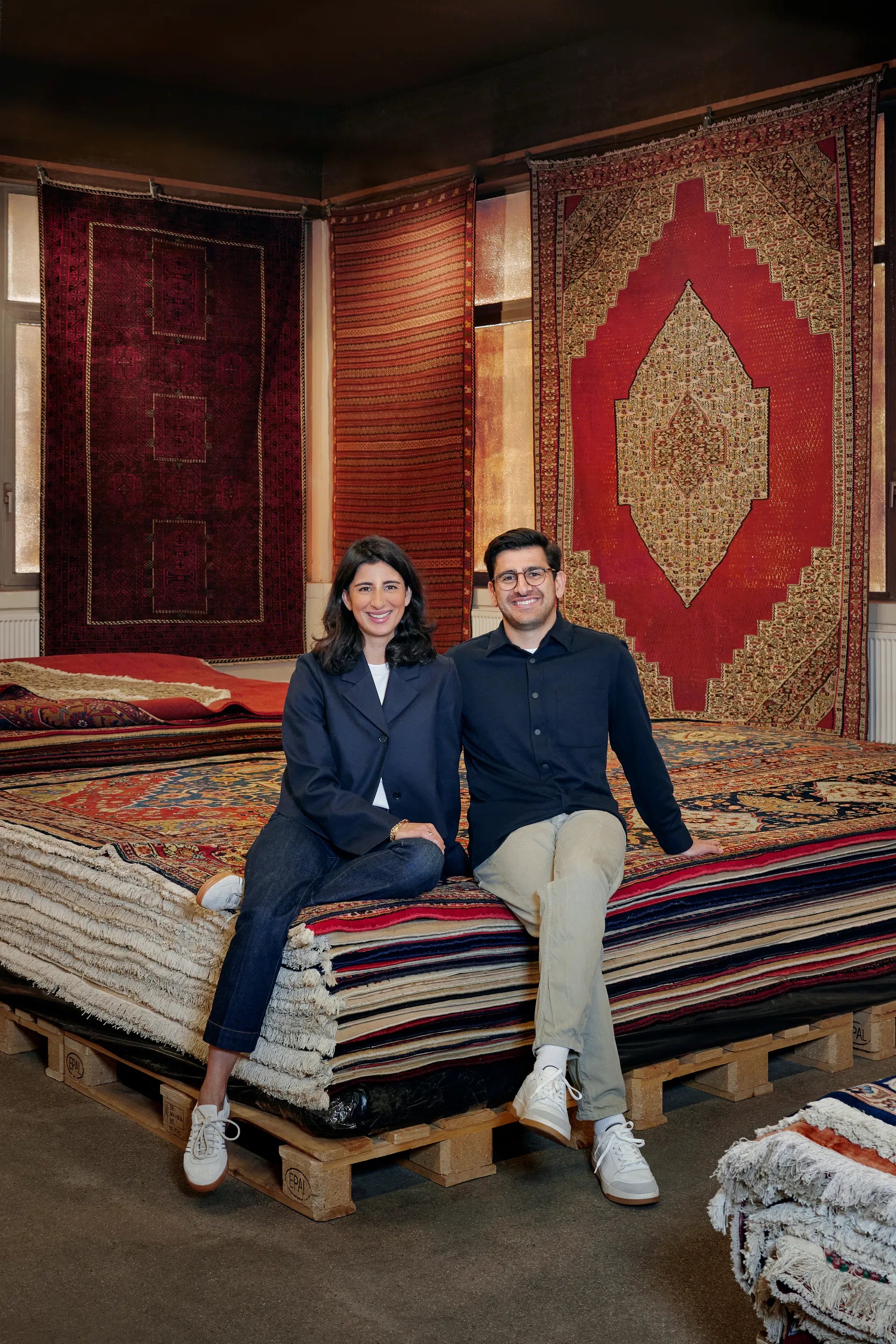
{{EXPERT_QUOTE:amin|“Over the years, I've inspected thousands of rugs in our Hamburg warehouse. You develop a feel for it. A machine-made rug feels dead under your fingers; its reverse is stiff. But a genuine knot lives. It’s a tiny, imperfect signature of the weaver. This isn't esotericism; it's pure craftsmanship physics.”}}
The most crucial indicator is the individual knot. In a hand-knotted rug, each knot is individually tied by hand around the warp threads. On the reverse, You will see tiny, slightly irregular squares – these are the knots. Machine-made rugs only have continuous weft threads that hold the pattern, but no genuine, individual knots. This difference is fundamental and reveals everything.
Turn the rug of Your choice over and run Your fingers across the reverse side. Do You feel small, raised points, almost like Braille? These are the ends of the knots. With a machine-woven piece, the reverse is often flatter, more uniform, and You are more likely to see longitudinal and transverse lines rather than individual points. The structure feels mechanical and lifeless. The subtle irregularities of hand-tied knots, however, are like the rug’s heartbeat – proof of the human hand that created it. Each knot tells a tiny part of the story embedded in the rug.
Here is a simple comparison to help You quickly recognise the differences:
| Feature | Hand-Knotted Rug | Machine-Made Rug |
|---|---|---|
| Knots (Reverse) | Individual, visible knots; slightly irregular | No individual knots; often just lines or a grid |
| Pattern (Reverse) | Clear mirror image of the front | Often indistinct, obscured, or distorted |
| Fringes | Integral, part of the warp threads | Separately sewn on, glued, or absent |
| Edges (Shirazi) | Hand-wrapped, slightly irregular | Machine-serged, perfectly uniform |
| Material | Natural fibres (wool, cotton, silk) | Synthetics (polypropylene, polyester, viscose) |
| Symmetry | Subtle, charming irregularities | Perfectly symmetrical, flawless |
This table summarises the key points. The {{LINK:collection:feine-stadtteppiche-1|fine knotting of Persian city rugs}} particularly highlights how precisely, yet still humanly, these knots are placed.
2. The Fringes: Sewn On or Grown From?

Authentic fringes are the ends of the warp threads – the rug's skeleton. They are an integral part of its structure and not added afterwards. If the fringes look like a separate band sewn on, it is highly likely to be a machine-made rug. Genuine fringes feel organic and flow seamlessly into the rug itself.
Imagine the rug as a woven fabric. The longitudinal threads stretched on the loom are called warp threads. They form the foundation. The fringes are nothing more than the extended ends of these warp threads. They have, in a sense, "grown out" of the rug. In an authentic piece, You can often follow the line where the knotted pile ends and the pure warp threads continue as fringes.
To check this, take a single fringe between Your fingers and pull gently. You will feel that it is firmly anchored in the weave. Try to look closely at the base of the fringe. It should emerge directly from the rug’s body. In contrast, with a machine-made rug, fringes are often sewn on or even glued as a purely decorative element. You will recognise a clear seam or an artificial edge where the fringes have been attached. This simple test is one of the quickest and most reliable ways to unmask a fake.
3. The Material: A Test for the Senses
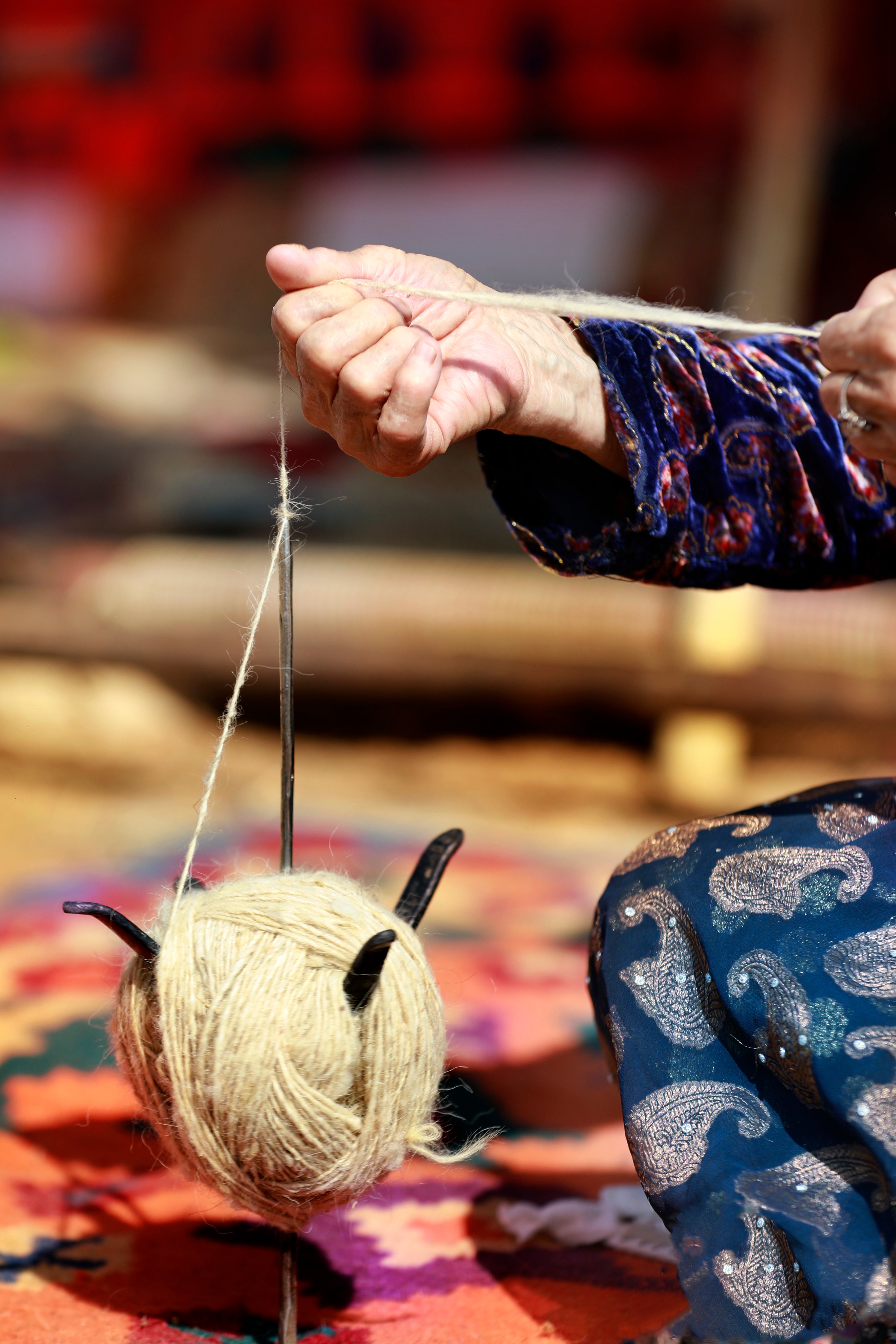
Authentic rugs are made from natural fibres such as virgin wool, cotton, or silk. Wool feels robust, slightly greasy (due to lanolin), and has an earthy scent when rubbed. Synthetic fibres like polypropylene often feel smooth, cold, and artificial. A simple sniff test or the feel on Your skin can often provide initial clues.
The choice of material is no accident; it is the result of centuries of tradition. Virgin wool from mountain sheep in the Persian highlands is rich in lanolin, a natural wool fat. This not only makes the rug dirt-repellent and robust but also gives it a unique tactile quality. Rub Your hand firmly over the pile. Genuine wool will warm up and emit a subtle, earthy scent. Synthetics, on the other hand, remain cool, can build up static electricity, and may smell chemical or of nothing at all.
The warp and weft, the invisible framework, are made of cotton in most nomadic rugs. It is stable and less prone to distortion than wool, giving the rug its shape. In very fine pieces, such as those found in {{LINK:collection:nain|Nain rugs}}, silk is also used for the pile to allow for even finer details. If You want to learn more about {{LINK:pages:kunsthandwerk|traditional craftsmanship}}, You will see how deeply material knowledge is rooted in weaving cultures.
4. The Reverse Side: The Honest Face of the Rug

The reverse side of a hand-knotted rug is almost as clear and detailed as the front – a mirror image of the pattern. You can feel and see the individual knot points as small nubs. In machine-made rugs, the reverse is often obscured by a coarse grid structure or a stiff finish. The clarity of the reverse is a strong indicator.
The reverse side doesn't lie. While the front, with its sheared pile, forgives minor irregularities, the reverse reveals the true structure. Every single knot made by the weaver is visible here as a small, coloured square. The entire pattern of the front should be precisely mirrored on the reverse. If the pattern on the reverse is blurred, indistinct, or covered by a sewn-on grid, You should be suspicious. This is a typical sign of machine production, where the pile is often shot into a backing material and the reverse side is glued or laminated for stabilisation.
{{ANECDOTE:hamburg|Just recently, a customer was here at our Hamburg warehouse who had inherited a rug. She was unsure of its value. We turned it over together. The front was a little faded, but the reverse… it was like a map. You could see every single knot, the subtle colour changes of the yarn. The pattern was razor-sharp. We both knew immediately: this was a genuine piece of history, not a soulless mass-produced item.}}
5. The Perfection of Imperfection: Abrash and Design
Absolute perfection is a sign of machine work. Hand-knotted rugs thrive on small irregularities. These include slight colour variations in the yarn (Abrash), which arise from natural dyeing processes, or minimal deviations in the symmetry of the pattern. These "imperfections" are, in truth, the weaver's signature and a valuable authenticity feature.
A computer designs and a machine weaves with absolute precision. Every thread has exactly the same colour, every medallion is perfectly centred. A human cannot and does not want to achieve that. It is the charming "imperfections" that give a hand-knotted rug its soul. The best example of this is what is known as Abrash. When wool is hand-dyed in small batches with natural colours, minimal colour differences always occur. When the weaver then starts a new thread, this later appears as a gentle, striped shading in the rug.
In the past, this was seen as a flaw, but today it is a celebrated sign of authenticity. It proves that the rug was not made with industrially dyed yarn. If You are wondering {{LINK:blog:was-ist-abrash|what Abrash is exactly}}, we have a dedicated article on the subject. Small deviations in symmetry or in the width of the rug are also normal. They arise because the rug was knotted on a simple loom under the influence of human hands and the elements. These signatures are particularly pronounced in {{LINK:collection:nomaden-dorf|nomadic and village rugs}}.
6. The Edges: Handmade to the Finish

The lateral edges of a rug, also known as Shirazi, are hand-wrapped around the outermost warp threads to protect them. This wrapping is often slightly irregular and firm. Machine-made rugs have edges that are machine-serged quickly and perfectly uniformly with a single thread. The craftsmanship of the edge is a detail for connoisseurs.
The long sides of the rug need particular protection as they are subject to heavy wear. In a hand-knotted rug, this edge is hand-wrapped with a wool thread. This technique is called Shirazi. It is firm, robust, and conforms to the rug. If You look closely, You will notice that the stitches are not 100% identical – a clear sign of handwork.
Machine-made rugs often have an edge that has been serged with a sewing machine and a single, continuous thread. The result is a perfectly uniform, almost sterile edge. While it looks neat, it lacks the firmness and character of a hand-crafted Shirazi. Should this edge ever be damaged, it is {{LINK:pages:teppichpflege|professionally repaired}} in our Hamburg warehouse to preserve its original character.
7. Certificates and Origin: Who Can You Trust?
A suspiciously low price for an allegedly hand-knotted rug is often a warning sign. Reputable dealers offer transparency about the origin and are often certified by labels such as CARE & FAIR or STEP, which guarantee fair working conditions. Trust specialist dealers with a long tradition who vouch for the authenticity of their pieces.
A hand-knotted rug is the result of hundreds, sometimes thousands of hours of work. This effort comes at a price. If an offer sounds too good to be true, it usually is. A dealer offering their rugs for a fraction of the usual market price can hardly be selling fairly produced handmade goods. At Rugtales, in our history since 1952, we have {{STAT_BLOCK|Rugtales internal data}} assessed over 6,290 hand-knotted pieces and know what goes into each one.
Look for transparency and recognised labels. Certificates like {{LINK:pages:label-step|the STEP label}} or organisations such as {{LINK:pages:care-fair|CARE & FAIR}} advocate for fair wages, good working conditions, and against child labour in weaving communities. A reputable dealer will proudly tell You about their certifications and the origin of their rugs. Our family tradition since 1952 is a commitment for us to work only with partners we trust and who share our values of craftsmanship and humanity.
FAQ
Can I, as a layperson, distinguish a genuine rug from a fake?
Yes, absolutely. With the tips provided, especially by closely examining the reverse side and the fringes, You, even as a layperson, can find strong indications of authenticity. The knot test is the safest and simplest way: if You see and feel individual, slightly irregular knots on the reverse, You are likely holding a genuine piece.
Are irregular fringes a good sign?
Yes, slight irregularities in the length or thickness of the fringes are a very good sign. They indicate handwork, as they are the ends of the hand-stretched warp threads and are not machine-trimmed to a perfect length. Perfectly identical, ruler-straight fringes are often a characteristic of machine manufacturing.
What is ‘Abrash’ and why is it a quality feature?
Abrash refers to the natural colour variations in a rug's yarn. These occur when wool is hand-dyed in small quantities, causing each batch to take on a slightly different shade. It is not faulty dyeing, but a highly valued sign of authenticity, proving that traditional methods, not industrial uniform processes, were used.
Why is the reverse side of the rug so important for authenticity verification?
The reverse side doesn't lie. It reveals the true construction of the rug without concealing anything with the pile from the front. Visible, individual knot points and a clear, detailed mirror image of the pattern are physically only possible with genuine hand-knotting. A concealed, indistinct, or grid-like reverse side is a strong warning sign.
Must a genuine rug always be made of wool?
No, although wool is the most common material for the pile. Genuine hand-knotted rugs can also be made of silk (especially fine and valuable pieces) or robust goat hair (in some nomadic rugs). The foundation, i.e., warp and weft, in most pieces consists of durable cotton.
Now that You know the seven most important features, You are well-equipped to recognise genuine craftsmanship. Why not explore the diversity in our {{LINK:collection:alle-teppiche|collection of all rugs}} and try to spot the details in the images? With our {{AR_VISUALIZER}} You can even project each unique piece directly into Your home and view it virtually from all angles.